HIPIMS hybrid/super-imposed MF for a perfect magnetron sputtering process HIPIMS混合/疊加MF用於完美的磁控濺射工藝。

Power supply is very important in magnetron sputtering processes and applications. The latest advanced power supply from Magpuls is able to perform MF mode or HIPIMS mode stand-alone or combine both output waveform patterns via. hybrid (a waveform editor built in controlled by a linux chip) in one pulse unit or super-imposed MF pulse unit and the other HIPIMS unit for the best quality coating purpose.
電源在磁控濺射工藝和應用中非常重要。Magpuls 最新的先進電源能夠獨立執行 MF 模式或 HIPIMS 模式,或通過以下方式組合兩種輸出波形模式。混合(由 linux 晶片控制的內置波形編輯器)在一個脈衝單元或疊加的 MF 脈衝單元和另一個 HIPIMS 單元中,以實現最佳品質的塗層目的。

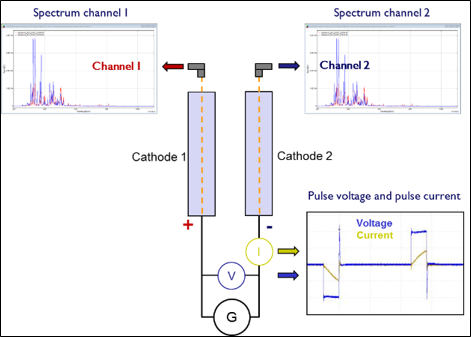
Here is an example of magnetron sputtering coating with MF hybrid HIPIMS. In this configuration, only one pulse is able to perform both MF and HIPIMS output waveform patterns designed via. PulsTrain waveform editor inside Magpuls pulse unit. The purpose is to save the money in the investment of coating tool.
這是使用 MF 混合 HIPIMS 進行磁控濺射鍍膜的示例。在這種配置中,只有一個脈衝能夠同時執行 MF 和 HIPIMS 輸出波形模式。Magpuls 脈衝單元內的 PulsTrain 波形編輯器。目的是節省塗裝工具的投資資金。

The other example is to combine MF pulse unit with the other HIPIMS pulse unit in the super-imposed configuration. In this configuration, the cost is much higher.
另一個例子是將MF脈衝單元與其他HIPIMS脈衝單元組合在一起,形成疊加配置。在這種配置中,成本要高得多。

In both hybrid and super-imposed configurations, the bias and related pulse units must be well-synchronized to obtain the best coating performance.
在混合和疊加配置中,偏置和相關脈衝單元必須保持良好同步,以獲得最佳鍍膜性能。

What is the purpose of using remote LAN control via EMICON RC DLL? (使用LAN遠端控制的目的)

主要目的是從中央控制室(很遠處,在無塵室外頭)要掌握生產線上使用的每一個EMICON工作站(個別IP)的狀況,以及從中央控製室對各別的EMICON線上工作站下達對應製程的製程參數(RECIPE)。例如: 對大型設備而言,特別是多腔體(multi-chamber)的生產線,線上有很多套EMICON工作站。

單一機台(設定localhost)使用的目的,在於把EMICON隱藏起來,不讓別人知道他們使用的是EMICON。
另一個目的在於有效整合自己的程式系統,或是製作他們自己要用的統計資料來做線上的用途。

Homogeneity & Uniformity

Definitions

Usually the definitions of two important quality factors – homogeneity and uniformity – are easily mixed up in a deposition process no matter which coating technologies are involved.  Note that many articles, papers or technical notes made the same confusion.  So, the definitions must be clear.

Homogeneity generally considers a very local spot area and measure/check the layer properties along the direction of the layer grown.

Uniformity considers the differences or tolerances among several measured data along one axis or in a big XY-plane area.

PEM system normally takes the responsibility of layer’s homogeneity control.

Uniformity can be achieved if the process chamber has a good layout or configuration for reactive plasma process.


Homogeneity

To achieve a good homogeneity layer, PEM system was introduced to reactive plasma processês to ensure the composition fraction (or alloy fraction) in each compound or molecules formed by the reactive plasma process is nearly constant.

In general, a PEM system is able to handle magnetron reactive sputtering in a distance range 500mm-600mm along the long axis of magnetron for a good PID closed loop control under the operating pressure range: approx. 0.8mTorr~10mTorr. In this example, a SiOx layer is grown by a dual magnetron sputtering sources with a process control by a PEM system.  PEM system varies the oxygen flow quickly to fit the setpoint by a fast response PID calculation to give a feedback voltage to control the oxygen flow rate. A good PID closed loop control can bring the alloy fraction factor x in each grown SiOx layer has an almost constant x value in different growth time, for example:  T1, T2, T3 and T4.
This is what PEM system contributes to get a high homogeneity layer.

Uniformity

Uniformity is a very important factor to be concerned and it’s very complicated because there are many factors that can influence it.  Generally, process chamber’s configuration is most critical to get a good uniformity of the grown layer.

This example has 3 measuring points over the width 1300mm of the PET film to compare the thickness, refractive index and other data corresponding to the uniformity in 3 locations in the same XY-plane on the surface of PET film.
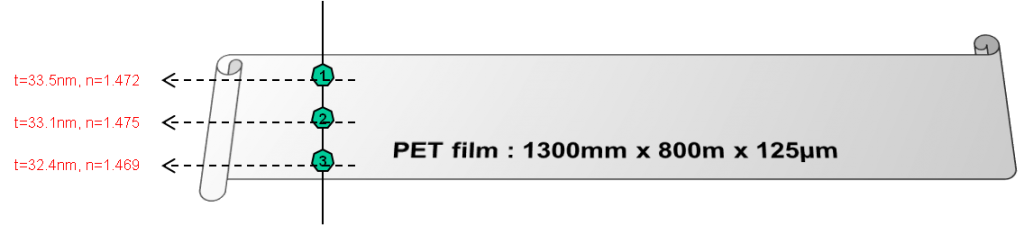
The factors often influencing the uniformity include:

-Pumping: if the pumping ports can not provide good pumping speed and the gas distribution inside the process chamber is not good, the uniformity would be influenced.
-Gas piping: if the gas piping delivering the reactive gas can not deliver the gas into the reactive plasma zone in the shortest time evenly, the uniformity would be influenced.
-Magnetrons: if magnetic constraint for electrons is not uniform, the uniformity would be influenced.
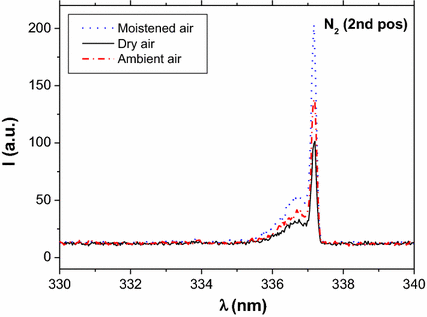
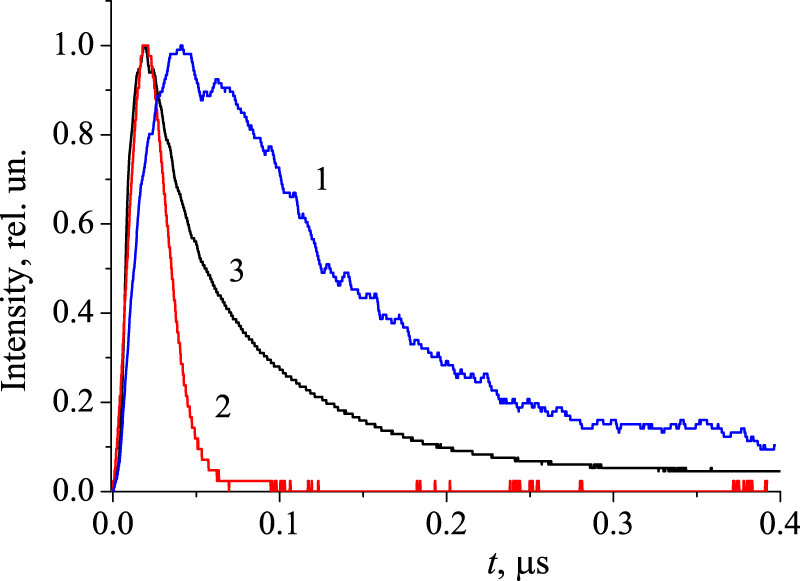


What’s the difference between the intensity listed in the database and the actual measurement?

This is an interesting question asked often while one touches and senses the plasma by optical emission spectrometry.


The radiation we are measuring with the EmiCon OES system is due to a two-step process in the plasma:

1. Ground state atoms are excited by electron collisions in higher electronic levels. The density of the excited atoms in a specific electronic level depends on the energy gap between the ground state (0 eV) and the higher electronic level and the electron temperature (i.e. electron energy distribution function EEDF, often Maxwelliam). The larger the gap the less is the density of the atom in this specific energy level.

2. From the higher electronic level the atom is decaying by spontaneous emission to some lower electronic level. This is the radiation we are measuring. The intensity given in the SpecLine database is the probability that the atom in the specific higher electron level will decay into the given lower electronic level.

This means for the Hg spectrum:
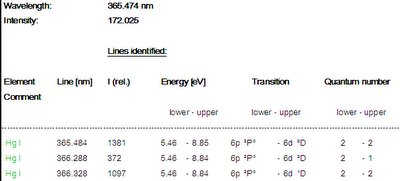
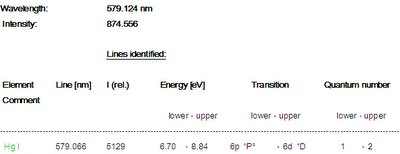
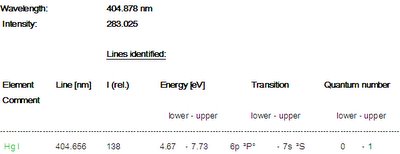
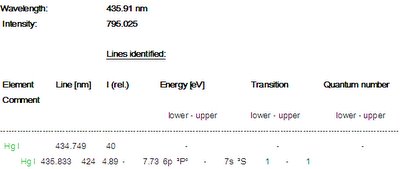
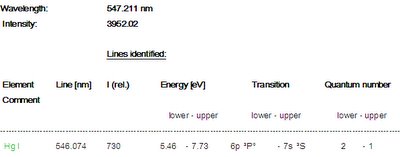
A.The lines at 404 nm, 435 nm and 546 nm are all decaying from the electronic level 7s2S with energy 7.73 eV. These there lines show an intensity distribution as given by the intensity values of the SpecLine database.
B. The line at 365 nm is decaying form the electronic level 6p2P° with energy 8.85 eV and the line 579 nm is decaying from the electronic level 6p1P° with energy 8.84 eV. Allthough these lines have a higher probability to decay than the lines form the 7s2S level, the denstiy of atoms in the 6p levels is much smaller due to the higher energy of the excited level (8.85 eV and 7.73 eV for the 7s level).

In general, the intensity of a line is ruled first by the excitation process (i.e. the energy of the higher electronic level) and second by the probabilty of decaying form the higher level to a lower level.

The remaining differences in the intensities of the lines is due to the sensitivity distribution of the EmiCon system, i.e. the system is most sensitive between 450 and 550 nm and less sensitive below 400 nm.

~~~ supported by Dr. Thomas Schütte of PLASUS ~~~

Good coating protection by a honey comb protection device in front of a quartz collimator lens (PECVD process)

On a PECVD process to coat SiO2 layer with SiH4 precursor reacted with oxygen, a quartz collimator with a honey comb protection device in the front to be mounted onto a KF25 flange.

setup of the collimator onto a KF25 flange

Continue reading “Good coating protection by a honey comb protection device in front of a quartz collimator lens (PECVD process)”

新一代的OES (EMICON)在等离子工艺应用上的重要性

回顾等离子工艺使用OES (Optical Emission Spectroscopy)的历史,早在1980年代,已有不少大型的玻璃工业尝试使用OES来协助等离子工艺在量化生产的稳定性,同时,也利用OES的特殊性能开发等离子工艺能够使用的新材料。1990年初期,OES著名的代表产品称为PEM (Plasma Emission Monitor)正式在生产大楼帷幕玻璃的等离子溅射流水线上使用,从single Low-e的能源玻璃进化到更具节能效果的double Low-e规范,到了1990年末期,更应用在平面显示器的镀膜工艺上。在2000年以前发展的PEM,多半采用 窄通滤光器 NBPF (Narrow Band-Passed Filter)搭配一个极为灵敏的 光电倍增管 PMT (Photo Multiplier Tube),透过一套单晶片的处理器计算侦测讯号强度与内部设定强度的差异,将差异值输出到控制反应气体的流量单元: 早期使用的多半是一个 流量计 (flow meter)搭载一颗 压电陶瓷阀 PZT  (Lead zirconate titanate: Pb[ZrxTi1-x]O3 0≤x≤1) valve,反应气体的流量经过变化,再次侦测等离子的强度,不断用回路的方式进行修正,让实际侦测的强度趋近内部设定值。为了稳定PEM的控制,PID计算的控制器也成为PEM Closed Loop Control (PEM闭锁回路控制)中很重要的一个角色。由于等离子工艺进步迅速,加上应用市场快速开发,对于镀膜的质量要求越来越严苛。不仅镀膜的质量在同质性(homogeniety: 镀膜期间随著厚度增加时的质量均匀性)的要求增高,同时对镀膜速率的提升也有很大的期许。

SpecLine分析等离子光谱的结果 (感谢德国PLASUS公司提供图片)

因此,2000年开始,新一代的PEM (EMICON: EMISSION CONTROLLER) 不再使用频宽不够精密的窄通滤光器,改用线性的电荷耦合器件CCD,大幅提升光谱的分辨率(resolution),不但谱线的位置准确,也因为光谱的分辨率提升,把主要用来监控的原子谱线与旁边夹杂的其他杂讯可以轻易地分离,让控制的范围加大且大幅改善控制的精度。这十年在分光仪的工艺上有长足的进步,不仅光谱的分辨率越来越好,也改善CCD的感光度,这些进步的优点,也替新一代的PEM EMICON打开更多应用的市场。虽然新一代的PEM EMICON在价格上较旧型的PEM贵了许多,但不可抹灭的,新一代的PEM EMICON提供更多更精准的性能让生产与研发有更好的信赖度与发展空间。长期使用的成本估算却是远较旧型要节省不少,最重要的是能够让生产线稳定,增加产能也增加营收。

现今,热门的应用如:大气等离子、大楼帷幕玻璃、平面显示器的生产、触摸屏生产、微机电、太阳能电池、半导体、装饰镀膜、超硬膜与光学镀膜都必须搭載新一代的PEM EMICON,来保障生产的稳定与信赖。

以下是新一代PEM EMICON在等离子工艺中不可或缺的几项重要特徵:

  1. 在过渡区域(hysteresis region)能快速有效地稳定在设定点
  2. 可提高镀膜速率(deposition rate)
  3. 可做线上的质量管理(online QC)
磁滞曲线

对于等离子工艺系统(或设备)商而言,新一代的PEM EMICON不但能够提升等离子工艺研发的能力,更可以建立自我的等离子工艺资料库,大幅缩短在客户端装机验收的时间,也能够提供客户快速的检修服务。特别是溅射的流水线(inline sputter coater)与批量型的生产机台(batch type),十分适用。除了等离子工艺的研发,同时也兼具等离子工艺系统(或设备)的除错功能,让设备商有能力自我改善设备的设计,让性能与稳定性提升。

反应式等离子溅射镀膜工艺的三宝

进行等离子溅射镀膜工艺时,有三项宝物是不可或缺的。

  1. 等离子工艺监控器 (plasma monitor and process controller)
  2. 脉冲式直流电源 (pulsed DC power supply) 或是 中频交流电源 (MF AC power supply)
  3. 磁控溅射靶 (magnetron sputtering source) 或称 阴极靶 (cathode source)

第1项的等离子工艺监控器主要负责镀膜的质量与镀率的稳定。

对反应气体(reactive gas)采用高速的PID闭锁回路控制(PID closed loop control),将检测到的等离子信号强度比对内部设定的预设值,根据比对的结果,转成电压信号将差异值输出到负责供应气体的质流量计(MFC: mass flow controller),改变供应气体的流量来修正实际等离子体实际反应的状态。再撷取改变后的等离子体的信号强度,又经比对产生修正的电压信号,重复修正气体流量来变化等离子体的行为表现。如此周而复始,一直修正到实测的等离子体信号与内订的预设值接近,甚至相同。在反应式的溅射镀膜期间,需要能够快速反应改变气体的流量,主要目的在于稳定溅射出来的金属靶材原子或分子与反应气体之间能够维持在一个固定的比例(合金比例)。如果,变化反应气体的速度太慢,合金比例只能在饱和区维持,且镀膜速率将会很慢。要能够提高镀膜速率又能改变合金比例且维持稳定的镀膜状态,这个等离子工艺监控器扮演极为重要且关键的角色。

PID Closed Loop Contorl

Continue reading “反应式等离子溅射镀膜工艺的三宝”

A New Honey Comb Device To Protect Expensive Quartz Window Of View Port

Wow! It’s a long time not to write an article in this blog. In the past years, a new developed honey comb device which provides a solution to solve the contamination problem on quartz window of view port. From time to time, the contamination onto the quartz (or pyrex) window of the view port coming from the processes of plasma CVD, etching, sputtering, arc PVD, evaportation PVD always raise up the maintenance costs and reduce the productivity. Nowadays a state-of-the-art honey comb device is well-developed.


Fig. 1 Up to 600°C without center ring in CF type; Up to 200°C in KF type.


There are several selections to fit the view port’s type and dimension. With the aid of this honey comb protection device, the quartz (or pyrex) window can be protected not to be contaminated. It’s also very easy to clean this device by following some simple instructions.

Fig. 2 Different diameters are available.


We are very appreciated in the pictures provided by PLASUS.

另外一個迷思: PEM的閉鎖迴路控制要用MFC或是PZT valve


繁體版


這是個在使用PEM閉鎖迴路控制時,經常遇到的問題:
到底要用MFC (Mass Flow Controller)就能夠擔負製程的重責大任? 還是需要使用PZT valve?
用一個很簡單的模型來分析就可以做出正確的判斷,不會選擇錯誤了。
要達成一個PEM閉鎖迴路控制的製程,需要下列的物件才能完成。
1. 感測頭: 將電漿光譜的光線收集傳遞給偵測器。這通常是由光學鏡頭與光纖組成的硬體,將光訊號傳遞到偵測器做光電訊號的轉換。因為是光速在傳遞訊號,所以需要的時間可以忽略。
2. 偵測器: 有感度十分靈敏的光電倍增管PMT (Photo-Multiplier Tube),通常轉換時間小於1 ns; 另外一種是CCD偵測器,轉換時間大約需要1~2 ms。
3. CPU / MPU軟體處理: 光訊號轉成電的訊號,經由電腦軟體的計算與處理產生可做控制的訊號輸出,需要的時間大約5-10 ms。
4. MFC或是PZT Valve: 控制反應性氣體流量的閥門從接收到電腦傳來的控制訊號到調整閥門開啟的大小到達指定的位置所需的時間,好的MFC最快可以在幾個ms達成,PZT Valve可以在小於1 ms內達成。
5. 氣體管路: 氣體經過氣閥後需要流經氣體管路到達真空噴出的位置,這段時間視真空鍍膜系統的真空抽氣設計來決定長短,通常需要20 ms(系統有很好的真空抽氣設計)到200 ms不等。
6. 擴散: 氣體抵達真空內部的噴嘴位置,會依照當時真空度的製程條件以擴散的方式離開噴嘴到達電漿製程的區域,這段時間通常小於1 ms.

重複這六個步驟就是一個完整的電漿反應性閉鎖迴路的控制流程。
因此,也很容易看出使用好的MFC大致就能滿足這種製程的要求了。


简体版


这是个在使用PEM闭环控制时,经常遇到的问题:
到底要用MFC (Mass Flow Controller)就能够担负工艺的重责大任? 还是需要使用PZT valve?

用一个很简单的模型来分析就可以做出正确的判断,不会选择错误了。
要达成一个PEM闭环控制的工艺,需要下列的组件才能完成。
1. 传感器: 将等离子体光谱的光线收集传递给传感器。这通常是由光学镜头与光纤组成的硬件,将光信号传递到传感器做光电信号的转换。因为是光速在传递信号,所以需要的时间可以忽略。
2. 传感器: 有感度十分灵敏的光电倍增管PMT (Photo-Multiplier Tube),通常转换时间小于1 ns; 另外一种是CCD传感器,转换时间大约需要1~2 ms。
3. CPU / MPU软件处理: 光信号转成电的信号,经由计算机软件的计算与处理产生可做控制的信号输出,需要的时间大约5-10 ms。
4. MFC或是PZT Valve: 控制反应性气体流量的阀门从接收到计算机传来的控制信号到调整阀门开启的大小到达指定的位置所需的时间,好的MFC最快可以在几个ms达成,PZT Valve可以在小于1 ms内达成。
5. 气体管路: 气体经过气阀后需要流经气体管路到达真空喷出的位置,这段时间视真空镀膜系统的真空抽气设计来决定长短,通常需要20 ms(系统有很好的真空抽气设计)到200 ms不等。
6. 扩散: 气体抵达真空内部的喷嘴位置,会依照当时真空度的工艺条件以扩散的方式离开喷嘴到达等离子体工艺的区域,这段时间通常小于1 ms.

重复这六个步骤就是一个完整的等离子体反应性闭环的控制流程。
因此,也很容易看出使用好的MFC大致就能满足这种工艺的要求了。